
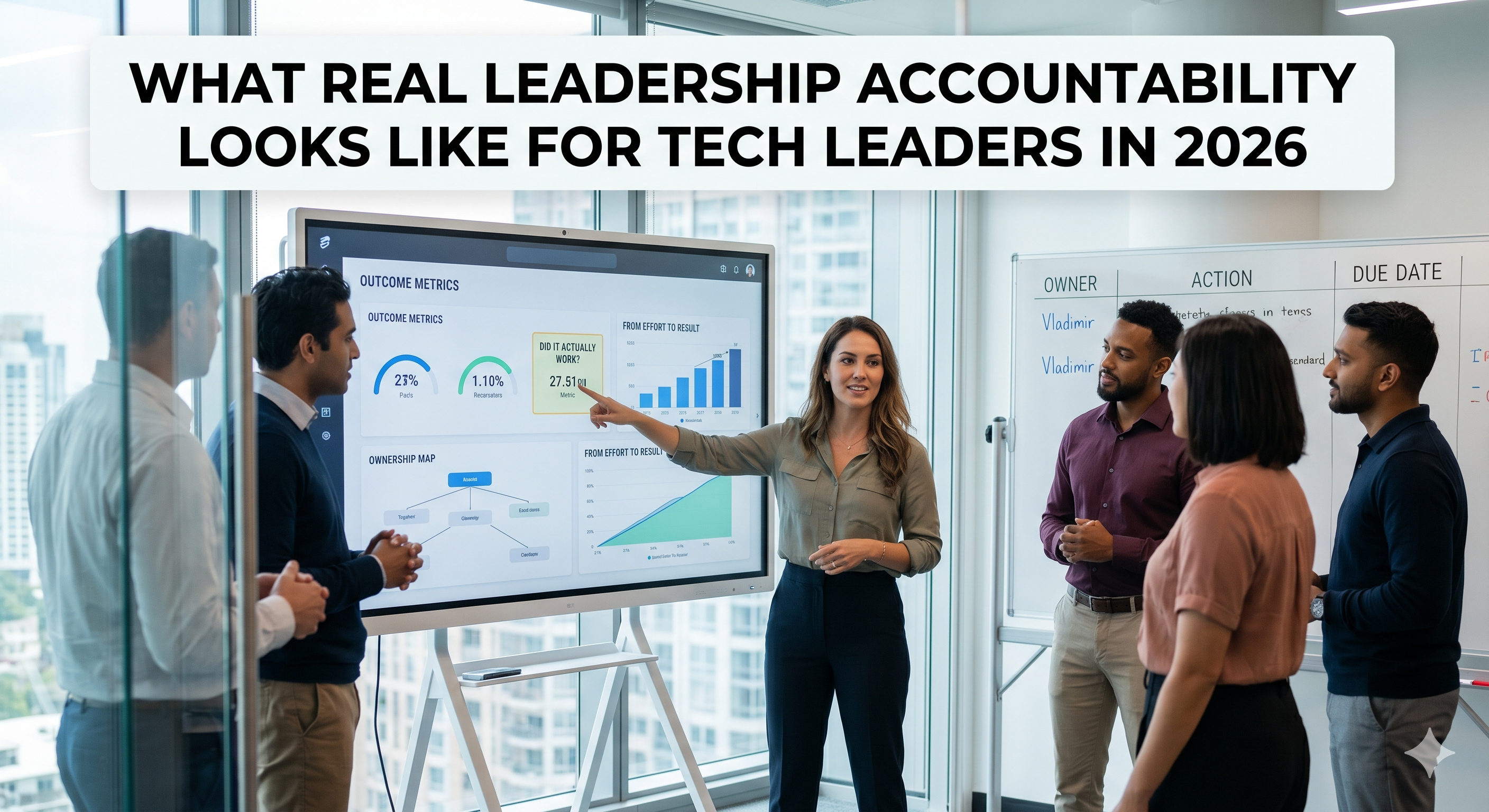
What Real Leadership Accountability Looks Like for Tech Leaders in 2026
Leadership accountability is one of the most misunderstood skills in tech, and the gap between what most leaders think it means and what it actually requires is quietly stalling careers.
Most tech leaders are working hard. Genuinely, consistently hard. And still not being truly accountable, because they’ve been measuring the wrong thing.
This post breaks down what outcome-based accountability actually looks like, why even high performers get it wrong, and the five specific habits that separate leaders who get trusted with more from those who stay stuck.
The Question That Changes Everything
Early in my career as a software developer at a large bank, I thought I was one of the most accountable people on my team.
I showed up early. Hit deadlines. Did exactly what was asked. I’d just pushed a feature. It ran perfectly. I’d checked every box.
Then my manager asked me something I wasn’t ready for: “But, did it actually work?”
I froze. Because I had never asked myself that.
The project hadn’t moved. The needle hadn’t budged. And I realized, I had been confusing effort with accountability. That confusion was quietly capping my career.
That one question is the foundation of everything in this post.
Why Smart, Hard-Working Leaders Still Fail at Accountability
Here’s the belief most leaders carry into every meeting, every performance review, every project:
“I did my part. I’m accountable.”
It sounds right. It might even be what your organization rewards.
But there’s a meaningful difference between “I did my part” and “Did it actually work?”
The first measures effort. The second measures ownership.
And the space between those two questions is where most leadership careers stall.
Effort-focused leaders stop at the edge of their job description. Outcome-focused leaders ask a different question after every action: Did that move anything?
That single shift, from effort to outcome, separates the leaders who plateau from the ones who keep getting trusted with more.
5 Accountability Shifts for Tech Leaders
-
Ownership Doesn’t Stop at Your Job Description
Real leadership accountability is wider than most leaders are comfortable with.
When I was that developer at the bank, I thought my accountability ended at my code. My task, my output, done.
What I didn’t understand was that accountability isn’t a boundary. It’s a posture.
Real ownership means that if something is in your world, formally assigned or not, it’s yours to address.
- The meeting running over time? Yours to address.
- The tension between two colleagues nobody wants to name? Yours to surface.
- The spec that’s technically done but doesn’t answer the actual business question? Still yours.
This isn’t about doing everyone else’s job. It’s about understanding that the leaders who rise fastest treat their scope as a starting point, not a finish line.
After my manager challenged me, I started attending meetings outside my formal scope. I mapped the infrastructure upstream and downstream from my work. I began to see clearly what was affecting my impact, and what impact I was generating for others.
The habit to build: Before you close any task, ask yourself, did this actually move the outcome forward, or did I just complete the activity?
Those are two different things. Learning to tell them apart is the first real shift.
-
Excuses and Explanations Feel Identical From the Inside
I was managing a product release when a key analyst on my team went out sick for weeks. The deadline started slipping.
I kept saying the same thing, to my team, to leadership, to myself: “It’s not my fault.”
And here’s the thing, I wasn’t wrong. It genuinely wasn’t my fault.
But I was confusing fault with ownership. And that confusion cost us weeks.
The explanations most leaders reach for aren’t lies. They’re usually accurate. The information was incomplete. The decision hadn’t come from above. The resource wasn’t available.
The problem is that an explanation, even a true one, describes what happened. It doesn’t change anything.
Accountable leaders ask a different question. Not “why didn’t it work?” but “what could I have done differently?”
And when you ask that honestly, there’s almost always an answer. You could have flagged the risk earlier. Escalated instead of waited. Restructured the timeline the moment the first signal appeared.
The difference between an explanation and an accountability mindset isn’t the words. It’s what you do next.
An explanation closes the loop on the past. An accountability mindset opens the door to what’s next.
-
“We” Is Where Accountability Goes to Die
The most accountability-killing word in leadership isn’t blame or failure. It’s this:
We.
“We’re working on it.” “We dropped the ball.” “We’ll follow up.”
It sounds collaborative. Even humble. But when everyone owns it, no one owns it.
I watched a leader run an entire organization like one big family, warmth in every meeting, good intentions everywhere. Underneath it all, nothing was clear. Two colleagues got into a public conflict and it went unaddressed for weeks because nobody wanted to name it. It was everyone’s problem. Which meant it was no one’s problem.
The fix isn’t complicated, but it requires courage.
One owner per outcome. Always. Not a team. Not a committee. One name.
Every open item ends with a name and a date. Not “we’ll follow up”, Vladimir will follow up by Thursday. Not “we dropped the ball”, I dropped the ball.
This isn’t about blame. It’s about creating the kind of clarity that allows trust to form. People don’t trust vague commitments. They trust specific ones, and the people who keep them.
-
Accountability Without Metrics Is Just Intention
Here’s a pattern I see constantly, even in high-performing teams.
Everyone is aligned. Energy is good. People are bought in. Three months later, nobody agrees on whether it worked.
That’s not a morale problem. That’s an accountability problem, and it started before a single task was assigned.
You cannot own an outcome you never defined.
The most accountable tech leaders I’ve worked with share one discipline: they define what winning looks like before the work starts. A clear, specific, measurable outcome. Not a direction. Not a vibe. A result.
Then they track leading indicators, signals that tell them whether they’re heading there, not just whether the work is getting done.
They make progress visible weekly, not quarterly. Because quarterly is too slow to course-correct, and too late to own anything meaningfully.
And when the numbers look bad? They get curious before they get defensive. Accountability isn’t about bracing for blame. It’s about owning what you learn and deciding what comes next.
Metrics without accountability are just numbers. Accountability without metrics is just intention. You need both, and the time to define them is always before you start.
-
How You Handle Failure Is the Real Signal
The best leaders I’ve coached have all failed. Some very publicly. And they talk about it, not to perform vulnerability, but because they’ve learned that how you handle a miss tells people everything about whether your accountability is real or rehearsed.
I watched an executive sit through a high-stakes demo failure at a robotics company. Public. Painful. Everything the team had built toward.
He could have pointed down. Named every factor outside his control. Instead, he owned it. Got to work.
Not because it felt good. Because he understood that the moment after failure is when leadership credibility is either built or permanently lost.
Here’s what accountability in failure looks like in practice:
Separate the outcome from the person. A failed project is not a failed leader. When you collapse those two things, you lose good people and build cultures where no one takes the risks worth taking.
Run honest postmortems. Ask “what did we miss as a system?” before you ask “who dropped the ball?” One builds. The other just assigns.
Close the loop with the people counting on you. They deserve to know what happened, what you learned, and what changes. That conversation is uncomfortable. It’s also where trust is either built or permanently lost.
Failure isn’t the opposite of accountability. Hiding from it is.
What to Do With This Starting Today
Leadership accountability isn’t about how hard you work. It’s about whether the outcome moved.
Here’s a quick summary of the five shifts:
- Expand your scope, ownership starts at your job description, it doesn’t end there
- Replace explanations with questions, “What could I have done differently?” is more powerful than “It wasn’t my fault”
- Name one owner per outcome, “we” diffuses the one thing that makes accountability real
- Define winning before you start, metrics give accountability something to attach to
- Own the failure, how you handle a miss is where real credibility is forged
The question I want to leave you with, the one that changed how I lead, is the same one my manager asked me years ago:
Did it actually work?
Not did you try. Not did you complete it. Not did you show up. Did it work?
Start asking that about everything in your world, and watch how quickly your team’s trust, your results, and your reputation as a leader begin to shift.
Want to find out where accountability gaps might be holding back your leadership? I’ve built a free assessment that surfaces the specific patterns keeping tech leaders stuck, and gives you a personalized suggestions report. Take the Leadership Assessment → Or if you’d prefer to talk through it directly, book a complimentary discovery call and we can determine together whether my approach is the right fit for where you are right now.
Frequently Asked Questions
What is the difference between accountability and responsibility in leadership? Responsibility is being assigned a task. Accountability is owning the outcome of that task, including what you do when things go wrong. A responsible leader completes the work. An accountable leader asks whether it actually worked, and takes ownership of the gap when it didn’t.
How do tech leaders build a culture of accountability without blame? The key is separating the outcome from the person. Blame asks who failed. Accountability asks what the system missed and what changes next time. Structurally, this means assigning one owner per outcome (not “the team”), defining success metrics before the work starts, and running postmortems that open with “what could we have done differently?” rather than “who dropped the ball?”
What does outcome-based accountability look like in practice? Before any project starts, you define a specific, measurable outcome, not a direction or vibe. You track leading indicators weekly to know if you’re heading there. You keep a single named owner for every deliverable. And when the work is done, you ask the most important question in leadership: “Did it actually work?” If yes, learn what drove that. If no, own the gap and decide what changes.
Why do high-performing leaders still struggle with accountability? Because most high performers were rewarded for effort throughout their careers, shipping on time, checking boxes, doing what was asked. Accountability at the leadership level requires a different orientation: owning outcomes beyond your formal scope, flagging risks before they become problems, and staying curious when things go wrong instead of explaining why it wasn’t your fault. The habits that made you a strong individual contributor can quietly work against you as a leader if you don’t make this shift consciously.
Vladimir Baranov is a certified executive coach (UC Berkeley) and the founder of Human Interfaces, an executive coaching practice for tech leaders and founders. He coaches C-suite leaders, engineering managers, and startup founders navigating the challenges that technical expertise alone can’t solve.
Decision-Making Under Pressure: Executive Coaching Strategies for Startup Founders
Mastering Leadership: How Founders Can Build High-Performing Teams