
Self-Awareness in Leadership: A Debugging Approach
Self-awareness in leadership is treated as non-negotiable, yet no one hands you the manual. For technical leaders trained to trust logic over soft skills, the human side can feel like undocumented code running in the background. This guide shares a debugging approach that turns vague advice into a system you can actually run and improve.
What Self-Awareness in Leadership Actually Means
For years I ran a set of mind processes without ever naming them. They were undocumented, working quietly in the background of every interaction. Labeling them was like finding the API docs for a tool I had used for years without knowing its name.
Once the label existed, I could finally see the thing clearly. That clarity sparked the curiosity to get better at it. Self-awareness stopped being an abstract virtue and became a skill with inputs, outputs, and a feedback loop.
I now picture it as a stack of variables: how I interact with others (external), with myself (internal), and with my environment (context). Self-awareness is the ongoing work of updating those variables as new feedback arrives, not a trait you either have or don’t.
The research supports the framing. Studies popularized by organizational psychologist Tasha Eurich suggest that while roughly 95% of people believe they are self-aware, only 10–15% actually are. Her two dimensions, internal (knowing yourself) and external (knowing how others see you), map cleanly onto that variable stack.
Why Leadership Exposes Your Blind Spots
You notice this model most when you move into leadership, because leading forces you to operate the human interfaces from the managing seat. The first attempts rarely work as expected. That is when you discover the model of the universe in your head is not the one running in everyone else’s.
I learned it by walking into rooms with the wrong assumptions. I once entered a room of non-technical colleagues assuming they shared my curiosity about how information flows through systems. I wanted to pull them into that process, got pushback, and reacted in a sequence I now recognize:
- Surprise – “Don’t you know this?”
- Mild judgment – “Why didn’t you spend time learning it?”
- Correction – “Oh, you have other priorities, and you’re good at things I’m not.”
- Genuine curiosity – “What are your priorities, and how do you actually decide?”
The fourth reaction was the only useful one. Accurately reading what was inside other people’s heads turned out to be the real key to self-awareness – more than any amount of introspection about my own.
The Mind Model Is a Map With Blank Regions
A quick note for the logic-first reader, which is probably most of you. My framework models people almost like systems, and yet my whole point is that people are not systems. Both are true, and that tension is exactly where the value lives.
A mind model is never an accurate representation of how someone thinks. It is a scaffold that shows what might be missing in an interaction, a map that highlights the blank regions worth exploring. Even a perfect map of someone’s brain would miss their current state, and the current state is what lets you understand the whole person in the moment.
The model’s real job is simple: flag where your data is missing.
Four Questions to Sharpen Leadership Self-Awareness
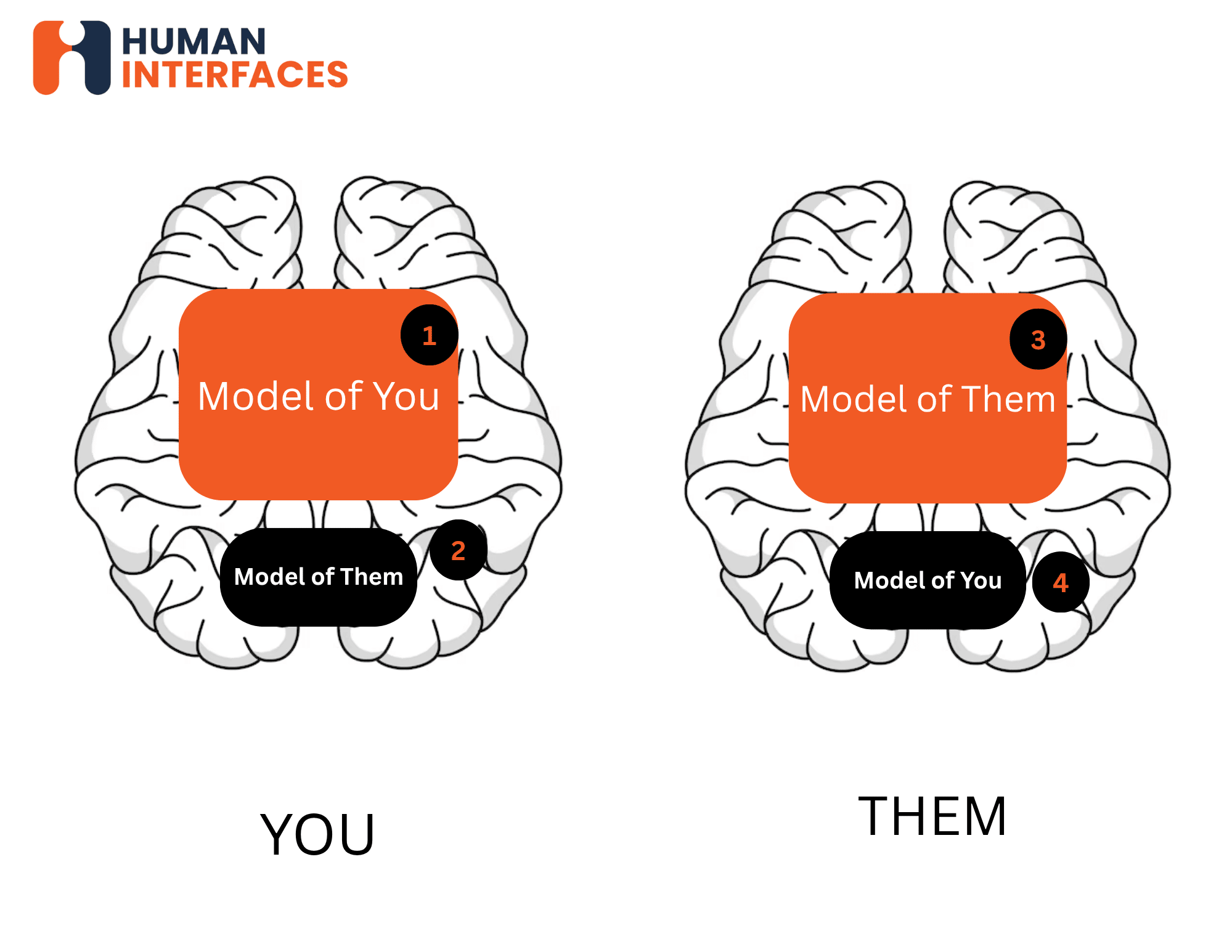
So how do you find the blank regions on purpose? Before an important conversation, I run four sets of questions. The need peaks around a crisis that has to be defused, but the same routine pays off in calmer moments too.
- My model of me. How do I see this situation, and what outcome do I actually want?
- My model of them. What do I think they believe about this, and what do they want?
- Their actual model. I ask them those same two questions directly, instead of guessing.
- Their model of me. How do they think I see this, and what do they assume I want?
That fourth question is external self-awareness in practice, the discipline of checking how you actually land on other people rather than how you hope you do.
The interesting part is the gap between set two and set three: my guess about them versus their real answer. When those diverge, I don’t treat either side as wrong. Positions aren’t right or wrong; they’re just different. I acknowledge the gap, ask clarifying questions, then build a bridge. The goal is never to change their opinion, only to create analogies or processes that let both sides keep working.
A Real Example: The Wrong Seat, Not the Wrong Skill
One case made this concrete. Someone assigned a technical task was executing it poorly. My model said skill or effort. Their actual model, once we talked, was that they never wanted to be in tech at all, they wanted a client-facing role. The resistance I read as a performance problem was really a person sitting in the wrong seat. The conversation is what surfaced the real state.
Reading the Room, and Reading Yourself
Some of my hardest lessons weren’t about other people’s models at all. They were about how badly I misread the signals right in front of me.
When Good Data Leads to Bad Conclusions
Nature gave me 20/15 eyesight, useful, but with a side effect. In my student years I would spot someone across campus, wave, and expect a wave back. It often didn’t come, so I concluded those people weren’t fond of me. The likelier truth took years: they simply couldn’t see me at that distance and were thinking about something else. My eyes generated data my inference then read completely wrong.
People Prefer Different Interfaces
An engineer I worked with rushed past me in hallways, stayed lukewarm at their desk, and wouldn’t acknowledge me at the store or the gym. Yet online we had phenomenal exchanges, frequent chats, emojis, images shared back and forth. Eventually I understood they were simply uncomfortable in person and felt they could communicate properly through a screen. So I stopped nudging the in-person channel and met them where they were already at their best.
Know When the Room Is Not Yours
Early in my career I supported traders on a desk. My first company was first-name and open, technical people were welcomed into business meetings, and traders and techies were on a personal basis. At the next bank I carried that assumption straight in, joined a huddle discussing a strategy, and offered my opinion. Silence. I had misread the culture, and didn’t even realize I was supposed to leave the group until I was explicitly told. One company’s culture does not transfer to another.
Control Your Body, Not Your Face
That last story made me far more conscious of how I come across, but I didn’t want to stifle my reactions into something fake. I can’t fully control my face, and I don’t want to; I want my reactions to be authentic. What I control is my body, keeping it signaling openness on purpose. My quick read of someone can easily be wrong, and open posture keeps information flowing instead of closing the loop too early on a guess.
One more caution: people’s facial and emotional expressions aren’t always controlled, and aren’t always a true reflection of how they feel about you. It takes several interactions to understand someone’s character, so I avoid over-weighting the first. Notice the feeling a first meeting gives you, don’t repress it, but withhold judgment. When it helps, consult a peer with exploratory questions like, “How’s your working relationship with them?” or “What do you notice they do well?”
What I’d Tell the Skeptical Technical Leader
Many science and tech leaders pride themselves on logic over soft skills. I share the instinct, so here’s the honest version. None of my communication classes were mandatory in engineering and science education. Our whole notion of communication ended up based on engineering books rather than on how communication actually works.
We’re trained to solve problems without the human context, and that training quietly teaches us the human context isn’t important. In the real world it’s at least half the outcome, often more. Had I discovered this earlier, I would have built a very different model of the universe, one that took the human interfaces as seriously as the technical ones, and recognized how much they shape the engineering itself.
The map of the person across from you is never complete. But knowing where it’s blank, and being willing to ask, is most of the job.
Key Takeaways
- Self-awareness in leadership is a learnable skill, not a fixed trait, treat it like a system you can debug and improve.
- Track three interfaces: external (others), internal (yourself), and context (environment), updating each as feedback arrives.
- Your model of another person is a map that flags blank regions, not an accurate picture of their mind.
- Run the four questions before high-stakes conversations, then close the gap between your guess and their real answer by asking directly.
- Withhold judgment on first interactions, people simply prefer different interfaces, and one data point isn’t character.
If you’re navigating the pull between logic and the human side of the job — whether that’s leading a team, scaling a company, or working through founder transitions – executive coaching for tech leaders gives you a confidential thinking partner to debug it with. Book a Discovery Call, and we can find out whether these methods fit your challenges. No pressure, just a conversation.
Frequently Asked Questions
Why is self-awareness important in leadership? Leadership forces you to operate through other people, so your effectiveness depends on how accurately you read them and yourself. Research suggests most leaders overestimate their self-awareness, which quietly erodes trust and decision quality. Treating it as a trainable skill closes that gap.
What’s the difference between internal and external self-awareness? Internal self-awareness is understanding your own values, reactions, and intentions. External self-awareness is understanding how others actually perceive you. Strong leaders develop both — the “fourth question” above, their model of me, is external self-awareness put into practice.
How can leaders improve self-awareness? Make it a routine, not a one-time insight. Before important conversations, map four things: your view, your guess about the other person, their real answer (ask directly), and how they see you. Pair that with honest feedback from people who will tell you the truth. This is also core to what emotional intelligence for leaders looks like in practice.
Can self-awareness actually be developed, or are you born with it? It can be developed. Self-awareness behaves like a skill with a feedback loop: you notice a signal, check your interpretation against reality, and update. The leaders who improve most treat blind spots as data to gather, not flaws to hide.
How is self-awareness related to emotional intelligence? Self-awareness is the foundation of emotional intelligence. Without an accurate read on your own state and how you affect others, empathy, regulation, and influence have nothing reliable to build on. That’s why coaching so often starts here.
Why Founder Coaching Works: The Hidden Algorithm Behind Clarity, Luck, and Action
CEO Coaching: Building Resilience and Emotional Intelligence